
Debt snowball vs avalanche: which is better?
The avalanche costs less. The snowball gets you a win sooner. On a lot of debts the gap is smaller than you'd think, and sometimes it's big.
By Sylviory Dubuisson · Updated November 2, 2026 · 6 min read
Say you owe money in three places, and after the minimums you've got some extra each month. Where should that extra go?
There are two well-known answers. The debt snowball says: the smallest balance. The debt avalanche says: the highest interest rate. People argue about this a lot, usually as if one side is obviously right. So we ran both on the same debts to see how big the difference really is. It mostly comes down to how expensive your worst debt is, and how big.
How the two methods work
Both start the same way. You pay the minimum on every debt, every month. Whatever is left goes to one target debt. When that debt hits zero, its old payment moves to the next target, so the total you put toward debt stays the same while the list gets shorter. That rolling payment is the "snowball."
The only real difference is the order:
- Snowball: smallest balance first, whatever its rate.
- Avalanche: highest interest rate first, whatever its size.
Three debts, both ways
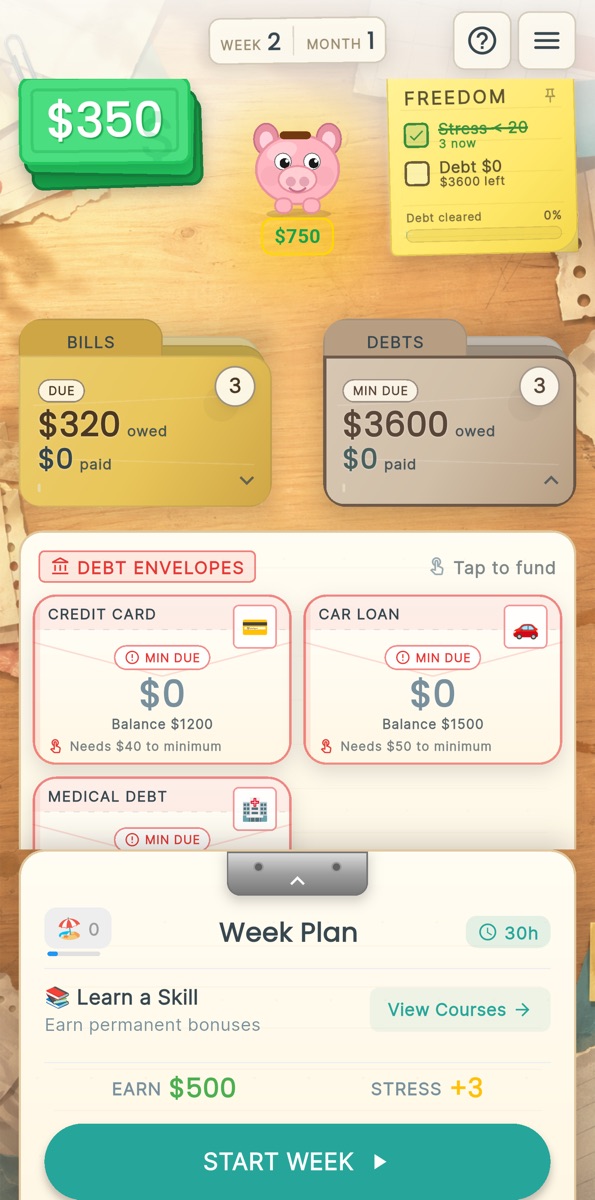
These are the debts in The Bounce Back, the free scenario in our game Debt Escape: one expensive credit card and two cheaper debts. You have $400 a month for all three.
| Debt | Balance | Interest | Minimum |
|---|---|---|---|
| Credit card | $1,200 | 24% a year | $40/mo |
| Car loan | $1,500 | 6% a year | $50/mo |
| Medical bill | $900 | 6% a year | $30/mo |
Here's the month each debt hits $0:
Snowball $147 interest
Avalanche $101 interest
The snowball clears the medical bill in month 3. The avalanche goes after the credit card and clears it in month 4. Both are done in month 10.
The avalanche costs $101 in interest and the snowball $147. So picking the "right" method saves $46 over 10 months. That's worth having, but it's not what you'd guess from how heated this debate gets.
Why do both finish in the same month? You're paying $400 either way, and a $46 difference is smaller than one month's payment. The order changes how much interest you pay, and not much else.
When the avalanche really pays off
The gap grows when your worst debt is expensive and big. Keep everything else the same, but make the credit card $5,000 with a $150 minimum, and say you can pay $500 a month.
Snowball
$1,113
interest · first debt gone in month 4 · done in month 18
Avalanche
$773
interest · first debt gone in month 14 · done in month 17
Now the avalanche saves $340 and finishes a month sooner. The catch is that you wait until month 14 to cross off your first debt. With the snowball, the medical bill is gone in month 4.
So the real question is whether $340 is worth going 14 months before anything disappears from the list. For some people that's an easy yes. For others, that's exactly where a plan gets abandoned.
Why the snowball has research behind it
The Consumer Financial Protection Bureau's guide to reducing debt puts the trade-off plainly. Paying the highest rate first "can save you money in the long run," though it may not feel like progress. With the snowball, you see progress quickly, but you may pay more.
That progress seems to matter. Kellogg researchers David Gal and Blake McShane looked at nearly 6,000 clients of a debt settlement firm. The number of accounts people closed predicted who finished the program better than the dollars they paid off. Their suggestion: start with the small balances, at least when the interest rates aren't far apart.
Run your own numbers
Put in your real debts and what you can pay in total each month. The math runs in your browser, and nothing you type is sent anywhere.
Snowball
—
Avalanche
—
Try both in Debt Escape
This choice is built into our game Debt Escape. In The Bounce Back you get the three debts above, a weekly paycheck, and surprise costs that don't care about your plan. The credit card grows 2% every month you leave it alone.
Every debt you clear also takes 20 points off your stress, which is the snowball argument turned into a game rule. Play it the avalanche way, replay it as a snowball, and see which run you actually finish.
So which one should you pick?
If one debt charges far more than the others and the balance is big, the avalanche is usually worth the wait. Run the calculator. If it says you'd save a few hundred dollars, that's real money.
If your rates are close, or your most expensive debt is also your smallest, the savings shrink to almost nothing. Then the snowball's quick wins cost you very little.
And if you've started a payoff plan before and stopped, take that seriously. A plan you finish beats a cheaper one you drop in month five. You can also mix the two: clear one tiny balance first to get going, then switch to highest rate first.