What's your FI number? How the 4% rule works
FI stands for financial independence: having enough invested that the money can pay for your life. Your FI number is what you spend in a year times 25. Here's where the 25 comes from, what it assumes, and why your spending moves it more than anything else.
By Sylviory Dubuisson · Updated November 15, 2026 · 6 min read · Lire en français
Someone online says they "hit FI" at 41. They mean their investments now cover their living costs, so working has become a choice instead of a requirement. The amount it takes to get there is your FI number.
The math in one line
Take what you spend in a year and multiply it by 25. Spend $40,000 a year and your number is $1,000,000. Spend $30,000 and it's $750,000.
The 25 comes from the 4% rule. If you take 4% out in your first year, the pot has to be 25 times that withdrawal. Notice it's built on what you spend, not what you earn. Two people earning $90,000 and $50,000 who both spend $40,000 have the same FI number. The one earning more just gets there sooner.
Where the 4% comes from
In 1994 a financial planner named William Bengen tested withdrawal rates against market history. He pictured someone retiring at the start of every year from 1926 on, with half the money in stocks and half in Treasury notes, taking 4% in the first year and then the same amount raised for inflation every year after. In no starting year did the money run out in under 33 years, and in most it lasted 50 years or more.
Four years later, three finance professors at Trinity University ran a similar test on returns from 1926 to 1995. For portfolios mostly in stocks, they called withdrawal rates of 3% and 4% "exceedingly conservative." Those two studies are where the rule of thumb comes from.
What the rule assumes
Both tests were built on retirements of about 30 years, U.S. market history, and a fixed withdrawal that rises with inflation no matter what markets do. Bengen was writing for clients retiring around 60 to 65. That's worth knowing before you lean too hard on the 25.
Morningstar redoes this math every year with forecasts instead of history. Its December 2025 report puts the safe starting rate for a new 30-year retirement at 3.9%, counting a 90% chance of money left at the end. A year earlier it was 3.7%, and in 2023 it was 4.0%. The rate moves with markets, so it's better read as a range than a promise.
Two things push it in opposite directions. Time pulls it down: Morningstar's tables show a shorter retirement supporting a higher rate, and someone who stops working at 45 needs the money to last well past 30 years. Flexibility pushes it up: the same research found that people willing to let their spending move with markets could start at nearly 6%. Here's what a few rates do to the target on $40,000 a year:
| Withdrawal rate | Times spending | FI number on $40,000 |
|---|---|---|
| 4% | 25× | $1,000,000 |
| 3.5% | 28.6× | $1,142,857 |
| 3% | 33.3× | $1,333,333 |
Going from 4% to 3% adds about a third to the target. That's the real trade-off in picking a rate: a lower one holds up over a longer stretch, and it costs years of extra saving.
Spending moves it most
Because the number is 25 times spending, every $100 a month you don't spend takes $30,000 off it. And it works twice, because that $100 can go into investments instead.
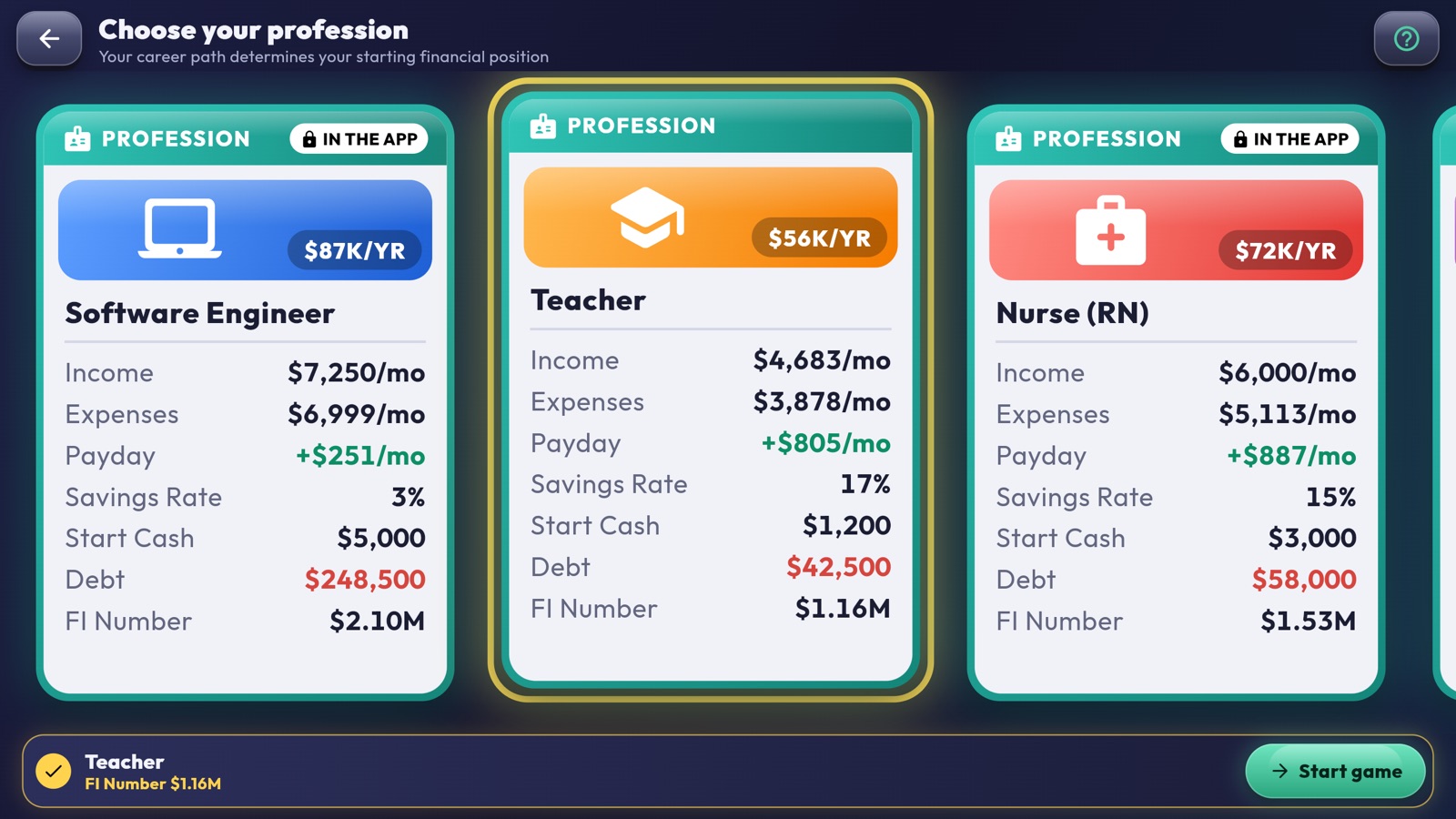
Take the Teacher career in our game Grind & Dream, whose budget is close to a real one. The Teacher spends $3,878 a month, taxes included, so the FI number is $1,163,400. Investing the $805 left over each month, at a 5% yearly return after inflation, gets there in about 40 years.
But $428 of that spending is debt payments: a student loan, a car loan and a credit card. With those gone, spending drops to $3,450 a month. The FI number falls to $1,035,000, the amount left to invest rises to $1,233, and the same math gets there in about 31 years. That's about 9 years sooner. Paying the debts off takes time and money first, so the real gain is smaller, but the direction holds. Our snowball vs avalanche guide covers which debt to clear first.
Income you don't have to sell anything for
Not all of it has to come out of the pot. Rent from a property, a pension, or a business that runs without you comes off your spending before you multiply. Spend $40,000 a year, collect $12,000 in rent, and the number is 25 × $28,000, or $700,000. Social Security works the same way, but only from the age it starts.
Find your number
Put in what you spend and invest. The time to get there uses the return you choose, after inflation, so every amount is in today's dollars. The math runs in your browser, and nothing you type is sent anywhere.
Your FI number
—
You get there in
—
Watch it move in Grind & Dream
Grind & Dream runs on this same math. Your FI number is 25 times your yearly expenses, and an FI bar fills as 4% of your stock portfolio plus your rental and business income catch up with your spending. Lifestyle cards raise your spending for good, and the number climbs with them. Repaying a loan lowers your monthly expenses, and the number drops.
When the bar reaches 100%, the game tells you work is now optional. It doesn't make you stop. Reaching FI and deciding to quit are two separate choices, in the game and out of it.