
How long will it take to pay off your credit card?
On minimum payments, a $5,000 card at today's typical rate takes about 19 years. Paying the same amount every month gets it done in under five, and the first payment is no bigger.
By Sylviory Dubuisson · Updated November 2, 2026 · 5 min read
Your statement shows a balance, a minimum, and a small box saying how long the minimum would take. Most people skip the box. It's worth a look, because the answer is usually counted in years.
We'll follow one card all the way through: $5,000 at 22% a year, with nothing new charged to it. That rate is close to the average on cards that charge interest, which the Federal Reserve last measured at 22.15%. The only thing we change is what you pay each month.
Why the minimum takes so long
Every card sets its own minimum, but a common formula is 1% of the balance plus that month's interest. On our card, the first minimum is about $142. Roughly $92 of that is interest, and only about $50 actually goes toward the $5,000.
Then the minimum gets recalculated from the new, slightly smaller balance. So it shrinks a little every month, the balance comes down more and more slowly, and the last several hundred dollars drag on at the $25 floor.
Paid that way, this card takes 230 months, which is 19 years 2 months. The interest comes to $8,100, more than the $5,000 you started with.
Pay the same amount every month instead
Here's the change that doesn't ask for more money this month. Take the first minimum, $142, and keep paying exactly that, even as the minimum on your statement drops.
Minimum only $142 every month
The fixed payment clears the card in 58 months (4 years 10 months) with $3,107 in interest. Same card, same first payment, and $4,993 less interest.
The gap comes entirely from the minimum shrinking. Every dollar it drops is a dollar that stays on the card and keeps collecting interest.
What paying more gets you
Same card, a few fixed payments, from the first minimum up to $500 a month:
| Every month | Paid off in | Interest |
|---|---|---|
| $142 | 4 years 10 months | $3,107 |
| $200 | 2 years 10 months | $1,750 |
| $250 | 2 years 2 months | $1,286 |
| $300 | 1 year 9 months | $1,022 |
| $400 | 1 year 3 months | $732 |
| $500 | 1 year | $574 |
The first step does the most. Going from $142 to $200 takes 24 months off. Going from $400 to $500, a bigger jump, takes off 3. Interest keeps falling all the way down the table, but the time you buy with each extra dollar gets smaller.
That's handy to know when you find a spare $50 or so a month. It shortens things most while your payment is still low.
The number already on your statement
Card statements have to show two numbers that help here, as the CFPB explains: how long the minimum alone would take, and how much you'd pay each month to clear the balance in 36 months. For our card, that three-year payment is about $191.
Both numbers assume you stop using the card. In the CFPB's words, they "do not take into consideration any future purchases." If groceries still go on it, the real finish line is further out than the box says.
Run your own card
Put in your balance, the card's yearly interest rate (the APR on your statement), and what you plan to pay each month. The math runs in your browser, and nothing you type is sent anywhere.
Your payment
—
Minimum only
—
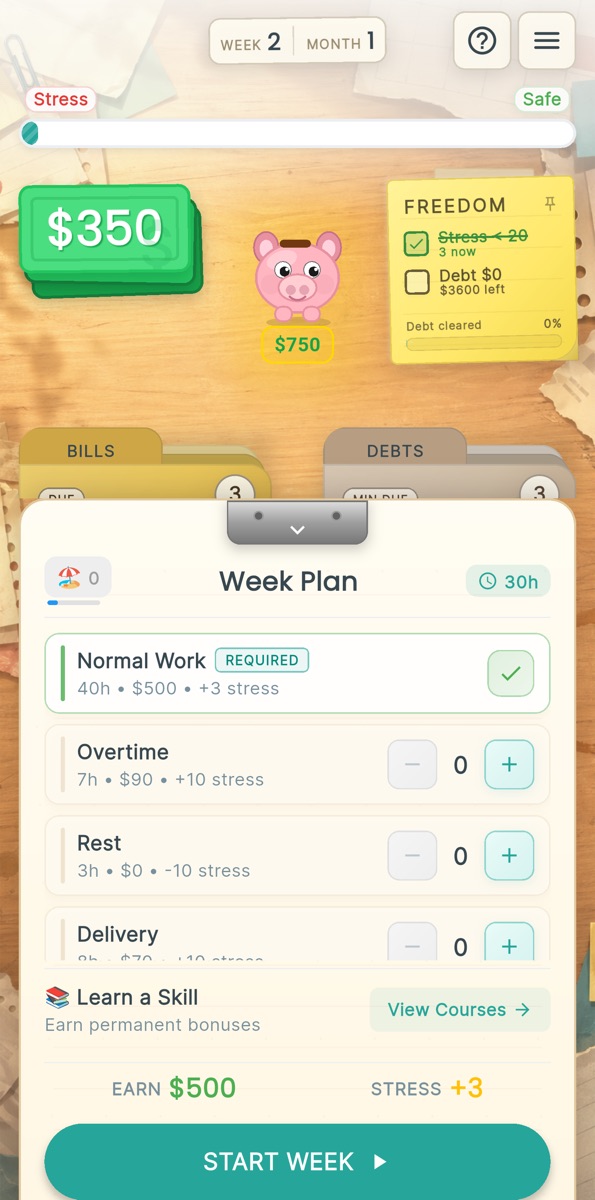
Practice it in Debt Escape
In The Bounce Back, the free scenario in our game Debt Escape, the credit card is $1,200 at 24% a year with a $40 minimum. Paying just that $40 would take 47 months and $651 in interest.
The game hands you a weekly paycheck and surprise costs, and each week you decide whether anything extra goes to the card. It's a quick way to feel how much a few dollars a week move the finish line, without risking your own money.
When no payment fits
Sometimes the calculator says $300 and your budget says $150. Two things are still true. Any fixed payment above the monthly interest gets the card to zero eventually, and the table shows that even the first small step up saves years. And you don't have to sort it out alone: a nonprofit credit counselor can go through your whole budget with you.