How to build an emergency fund on a tight budget
Start with $500, not six months of expenses. At $20 a week that's about six months away, and it covers the kind of surprise that often ends up on a credit card.
By Sylviory Dubuisson · Updated November 11, 2026 · 5 min read
The car starts making a noise. The mechanic says $400. Whether that's an annoying week or the start of new debt mostly comes down to one thing: whether there's money set aside that isn't already spoken for.
The $400 question
Every year the Federal Reserve asks adults how they'd pay for a surprise $400 expense. In its latest survey, 63% said they'd cover it with cash, savings, or a credit card paid off at the next statement. That number hasn't moved in three years.
The other 37% would find another way. In the Fed's breakdown, 15% of all adults would put it on a credit card and pay it off over time, 10% would borrow from family or friends, and 12% said they couldn't pay it right now at all. (People could pick more than one way.)
If you're in that 37%, you're not unusual, and you're not far from changing it. You don't need a big number. You need a first one.
Start with a number you can reach
You'll often hear three to six months of expenses. On a tight budget that can be so far away that it's easy never to start. The CFPB's guide takes a more practical line: think about the surprise costs you've actually had and how much they were, and set your goal from there.
We use $500 as the first stop. It covers the Fed's $400 example with room to spare, and it's the first milestone in our game. After that, $1,000. After that, one month of your essential bills. Each step makes the next surprise smaller.
How long it takes
Putting the same amount aside every week, with nothing taken out:
| Every week | To $500 | To $1,000 |
|---|---|---|
| $10 | 50 weeks (about a year) | 100 weeks (about 2 years) |
| $20 | 25 weeks (about 6 months) | 50 weeks (about a year) |
| $40 | 13 weeks (about 3 months) | 25 weeks (about 6 months) |
| $75 | 7 weeks | 14 weeks (about 3 months) |
$20 a week gets you to $500 in 25 weeks, about six months. $40 does it in 13. Neither is fast, but both have an end date, and that matters more than the amount.
The amount that works is the one that survives a bad week. If $20 means skipping a bill, $10 that you never skip gets you further. Moving it on payday, before the rest of the money gets assigned, means the decision only has to happen once.
What the cushion saves you
Say that $400 repair goes on a credit card at 22% a year and you pay the minimum. On a balance this small, the minimum sits at the $25 floor. It takes 20 months to clear, with $78 in interest. Paying $50 a month instead, it's 9 months and $37.
Honestly, the interest isn't the scary part. The scary part is 20 months of a payment that wasn't in the budget, while the next surprise doesn't wait for this one to be paid off. Our credit card guide shows how fast that adds up once the balance grows.
With $500 set aside, the same repair costs $400 and nothing more. At $20 a week, the cushion is back to full in 20 weeks.
Where to keep it
The CFPB's test is that the money is safe, easy to reach, and somewhere you won't be "tempted to spend it on non-emergencies." For most people that's a separate savings account at a bank or credit union, not the account your debit card spends from. Cash at home works in a pinch, but it can be lost or stolen.
Using it is the point
Decide ahead of time what counts: a car repair, a medical bill, a short paycheck. A sale doesn't. When a real one comes, use it without guilt. The CFPB puts it simply: "don't be afraid to use it if you need it," then build it back up. A fund that gets used and refilled is working exactly as planned.
Plan yours
Put in what you have now, what you can set aside, how often, and your goal. The math runs in your browser, and nothing you type is sent anywhere.
You reach your goal in
—
Practice it in Debt Escape
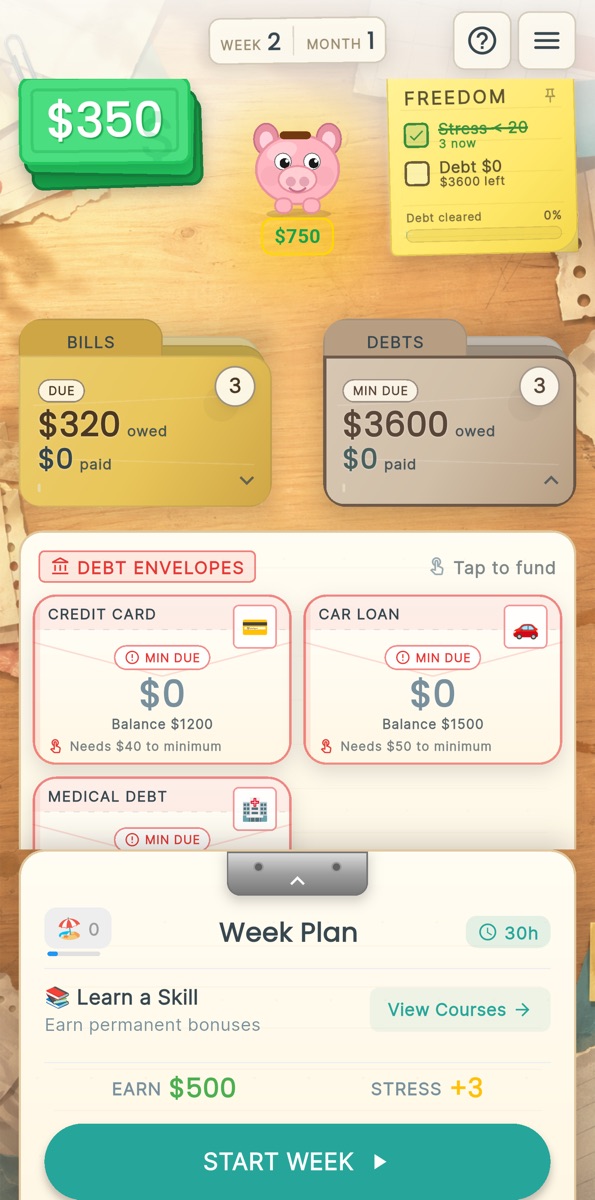
Our game Debt Escape has an emergency fund that holds up to $1,500. Every $500 in it lowers your stress a little, and when a surprise hits and your cash runs short, the fund covers the rest on its own.
Without one, a surprise you can't pay becomes a crisis loan: a new debt that grows 3% a month with a minimum of 10% of the balance. It's the game's version of the $400 on a credit card, and it's why one of the game's tips is to build the fund earlier.